Tuesday, October 22, 2013

Bear Rock to Miller's Pond, Durham

Uprighted tree - it fell over, was cut, and sprung back up. 
It took awhile to find the spot where the trail crosses Harvey Road, but eventually I spotted a very faded blaze and parked in small pull-off nearby. Before heading up to the promise that is Bear Rock, I had to take the trail south to Higganum Road where I left off last time. That was pretty quick and uneventful, although I did run across an uprighted tree.   Although it may look like someone got up on a ladder and cut this tree ten feet up for no apparent reason, that's not what happened. This is a tree that fell over, was cut in half as it lay on the ground, and then sprung back up as soon as it was released from the weight of the tree top. I've only seen this happen with trees in wetlands, I think because the roots are very shallow. 


It was then a quick climb up to Bear Rock. Near the top you get to choose between the main trail and Bear Rock Bypass. I took the main trail, which required a good rock scramble, steep enough that I had to take off my pack lest it tip me over backwards as I climbed. There really wasn't any good reason for the main trail to go up this way, so unless you are nimble and enjoy rock climbing, take the bypass. They both head up to the top. 

Looking north from Bear Rock
Scarlet Oak
The views were great and the weather perfect. I lingered for about 45 minutes. The leaves were in all sorts of colorful shades of reds and yellows.  The brightest color up on the rock was the vivid red of Scarlet Oak. Pretty obvious how it got its name.

There were lots of other oaks up there as well, with the various species turning different colors. The Bear Oak, more of a hill-top shrub, was going a burnt tan. Chestnut oaks were a yellow-green.
 
Bear Oak (left), Scarlet Oak (right), and Chestnut Oak (back left)

Enjoying the views with my hiking buddy.
After lunch, it was time to meander on over to Miller's Pond. I was wearing blaze orange on this day since it's hunting season and the trail crossed over both a State Forest and private property, two areas where it's best to assume there may be hunters. A pair of trekking poles was also helpful because the ground was uneven and covered with fallen leaves. There were a few steep sections, too. 

Another snake my dog stepped over without seeing.

Miller's Pond
 The blazes were pretty faded, but people had been walking the trail the previous weekend and it was possible to discern the tread with with all the freshly fallen leaves. Eventually Miller's Pond came into view and the trail descended a rocky bank to the water's edge, where someone had left a kind note to hikers.

Will wearing blaze orange help??

Miller's Pond State Park
The sunny, warm fall day was beginning to cloud over, and by the time I got back to Bear Rock, the sky was getting pretty moody. On the plus side, the absence of sun glare made the colors really stand out.

Moody sky

Looking towards Reed's Gap (Rt 68)

Thursday, October 17, 2013

Coginchaug Cave, Durham

Leaves changing color
Chestnut sapling
This next section of the NET spur runs 2.3 miles from Old Blue Hills Road to Higganum Road in Durham (remember to check the location feature at the bottom of this post to see the exact parking location on a map). The CFPA showed two features: Coginchaug Cave and Pine Knob Overlook.  

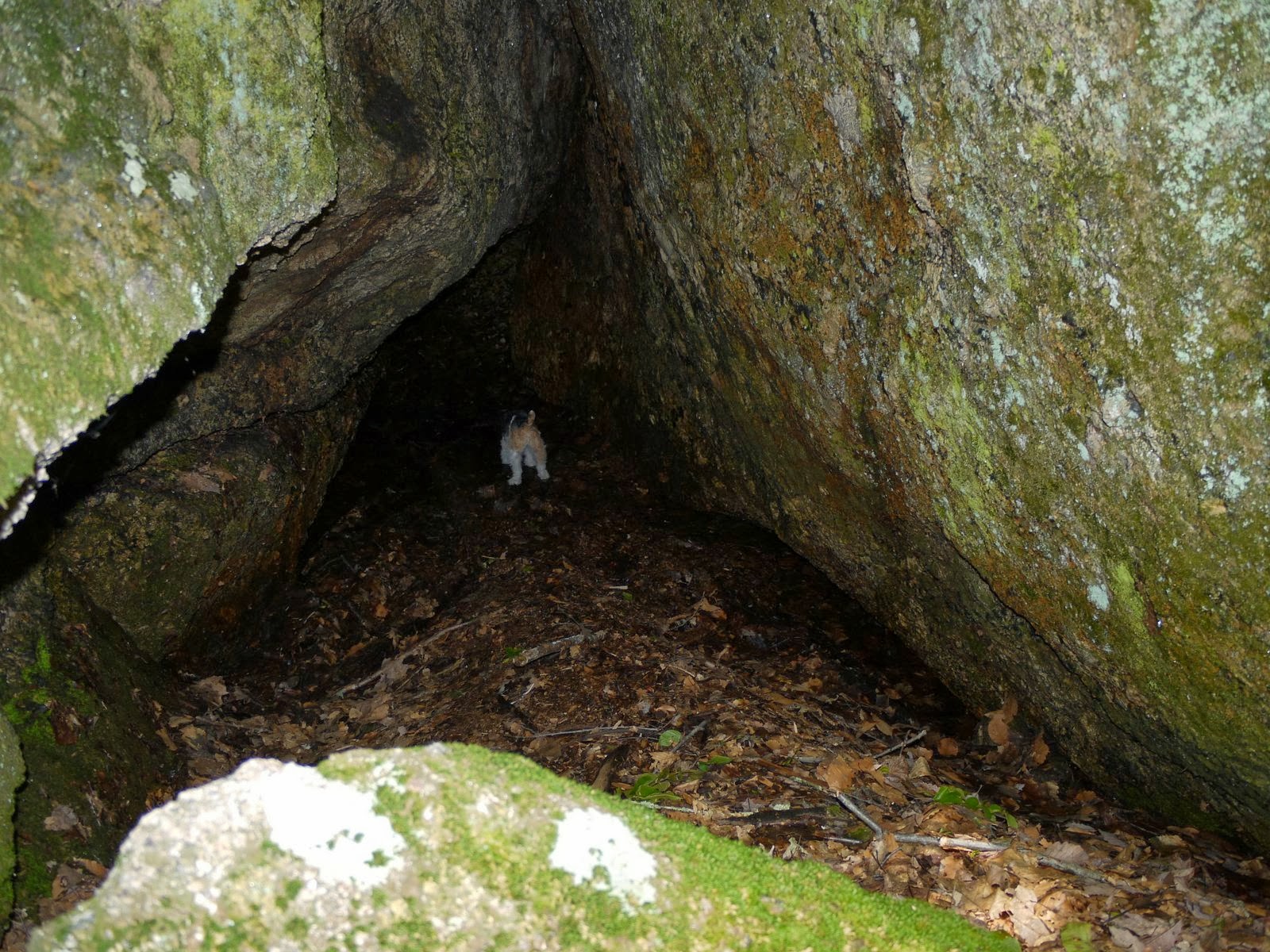
Coginchaug Cave - see dog for scale
In Connecticut, a large rocky hill is called a "mountain", and a large overhanging rock is called a "cave." Neither is technically true, but who cares?  This is the second largest cave I've seen in Connecticut, the largest being the Indian Council Caves along the Tunxis Trail.


Nice view from the cave

Looking back toward the mouth of the cave
Doll's Eyes Baneberry
Pine Knob Overlook was supposed to be off a spur trail just after the cave.  I missed the trail junction and headed towards Higganum Road. The hike was fairly uneventful. The woods were changing color and leaves starting to fall.

The trail was recently reblazed, and the new blazes were very, every crisp and neat. I mean, they were perfect. A lot of older blazes were covered over with gray spray paint, which I thought was odd since some of the eradicated blazes were in helpful locations.  Too many blazes can be unsightly, but not enough blazes make it hard to follow the trail without having to constantly stop and look around for it. It can be hard to get the right balance. I had to backtrack and mull about in one area for five or ten minutes because I just could not find the trail. Freshly
fallen leaves can really hide a trail, making the blazes more important.

Also, many of the old blazes were covered over and a new one painted just below it. Wrong height, or what? Blazes are supposed to be at eye level, but does six inches up the tree really make any difference?

Christmas Fern; new blaze painted right below an obscured blaze. 
.
Witch Hazel flower and seed pod
On the way back, I found the red/blue spur trail that lead to the Pine Knob Overlook and started up the slope towards a rocky knob. And all the sudden I came out on a street. A woman walking down the road saw me coming up the trail and asked if I was lost. I knew right away that the road must be new, and she confirmed it. "The overlook is in some guy's back yard now."  Great. I trudged back down the hill. No scenic vistas this trip.  But it was a lovely hike through peaceful woods, and I didn't even find any balloons.


Friday, September 20, 2013

Mt. Pisgah, Durham


Hiking season has arrived! Time to finish up NET spur.  I parked at the very end of Cream Pot Road, which has been extended recently in the form of a gravel road which has new houses under construction off of it, shortening the walk along the red/blue access trail. Picking up the blue blazes northbound (southbound takes you to Pyramid Rock), the trail quickly heads downhill to follow Chalker Brook along the bottom of a deep ravine, which was mostly dry during the hike. 

An area of old stumps in the ravine -- hemlocks?
After crossing the stream, there was an area with many large, rotting stumps surrounded by beech trees. I suspect these were once hemlock that the whooly adelgid killed off. 

Elmo "Get Well" Balloons
The trail was wonderfully quiet and peaceful all the way up to the top of Mt Pisgah. There is a short trail to an overlook part way up, but it turned out to be a seasonal view. Continuing on to the top I saw a bright red metallic object through the trees maybe 75 feet off trail. Exploring, I found a large set of metallic mylar balloons, the biggest set I've ever found, complete with a giant Elmo, and still partially inflated with helium *deep sigh*.  I imagine the ridge is pretty good at intercepting low-flying balloons. It must be, because I found two more sets of balloons near the top before the hike was through, including the remnants of a latex balloon and string alongside the trail. The latex eventually breaks down, although it can take a few years, and the ribbon takes longer. I picked up the litter and stuck it in my pack. The larger balloon set was too big to fit in my pack, so I left on the trail to pick up on my way back. 
According to the balloon industry, this is not litter.
According to the balloon industry, if something eventually biodegrades over a few years, and you throw it into the environment, it's not "littering."   So I guess I was picking up non-litter. 
Reaching the dry hilltop of Mt. Pisgah
The bald top of Mt. Pisgah was a real treat, with a great view to the north and west across the Connecticut Valley to the Metacomet Ridge. The mainline New England Trail pretty much follows the entire ridgeline in the distance. 
Biscuit's backdrop is the traprock Metacomet Ridge on the horizon. 

In the photo above, Beseck Mountain is to the left, then there is a little notch directly over Biscuit's head, where the Hanging Hills of Meriden can be seen in the far distance, then to the right is Mt. Higby.   

Reed's Gap with the heavily quarried Trimountain to the left.

I was able to quickly identify the features in my photos thanks to a Connecticut Environment Review Team report for Mt. Pisgah conveniently uploaded to the Internet, which included the nicely labeled photo below. The inventory report of the Mt. Pisgah Open Space was prepared for the Durham Conservation Commission.   The report has some interesting maps as well as little tidbits such as the top of the mountain is composed of a pegmatite. 

Screen shot from the CT ERT Study. 

The first acorns are falling
Continuing north from the top, there's a pleasant plateau hike before dropping down towards Route 79 (where I found another brightly colored mylar balloon). Shortly after sitting down at one point for a break, a large branch began to fall, crashing through the top of a tree, then seemed to get hung up. Suddenly the falling "branch" spread it's enormous wings -- it was a remarkable clumsy Turkey Vulture who was perhaps unnerved by my presence. It made quite a commotion trying to get out of the tree top. 

As soon as the trail began to really drop towards the East, I started hearing trucks on the highway. It was a quick hike down to Pisgah Road and back up again to retrace my steps.  

Nicely camouflaged Gold-Striped Leaftier Moth. See it? 


Biscuit has no idea there is a garter snake at her feet

On the way back, Biscuit stepped over a half-grown garter snake without seeing it. She does that a lot with snakes, even big ones. They freeze up, and she never sees them. 


I stopped to take a photo of the frozen snake, and Biscuit came on back and started sniffing the ground. She still did not see the snake, even though it was right under her nose, keeping perfectly still. Then Biscuit got too close, and the little garter snake went on the attack, chasing a very surprised dog down the trail a few steps, and striking several times, before heading into the woods. 

Snake goes on the attack! 

Biscuit wonders what just happened as the snake crawls away.


Tuesday, July 2, 2013

Mica Ledges and Pyramid Rock: In Search of Cicadas

Pyramid Rock
If you like lots of giant boulders covered with moss and ferns, as well as some great vistas, this hike is for you.  This was an impulse hike for me. My real goal was to encounter the tail end of the famous 17-year cicadas, which I've never experienced before, and which only occur in a few parts of the state. Guilford/Branford and the Metacomet Ridge was supposed to be a hotspot, so I threw my gear in the car and went driving around with my window down listening for the roar of cicadas. I drove to the various trailhead parking areas and all I heard was crickets. Disappointed, I switched to Plan 'B' and headed for Mica Ledges in Durham, the next leg of the NET. 


I parked at the end of Cream Pot Road, where some new houses are being built, and followed the blue blazes of the Mattabesett Trail southbound.  Where the trail intersected with the red trail of Mice Ledges, there was a big rock that could only be the Pyramid. I turned south onto the red trail. It was not the only massive boulder, there were several others covered in moss and polypody ferns along the red trail, but the shape was distinctive. 
Exploring a cave formed by two boulders.
 It was a beautiful park, nice and peaceful on a weekday, except for a very annoying mechanical sound coming from the new houses under construction. Sort of a like a compressor turning on and off, over and over, and I couldn't seem to get away from the sound. 
"Ha Ha I'm taller than you!"
Wintergreen
 The red trail eventually swung down a steep hill, and I suddenly realized the annoying mechanical noise was coming from two completely new directions through the forest. Wha??  I knew I had never heard this noise before... maybe it was an insect of some kind. What loud and repetitive insect had I never heard before in Connecticut?  The light bulb went off, and I used my Droid then and there to find recordings of a single 17-year cicada, rather than a chorus of cicadas. And that was it. I had found the cicadas after all, and they sounded nothing like I expected. Irony. After that, I wanted to get a recording of the sound with my camera, but they were too far away in the distance. But this is what it sounded like

Pond on the red trail
The trail brushed past a pond and more big boulders, then headed uphill to the ridgetop called Mica Ledges, where it ended in a "T" with the blue-blazed Mattabesett.  From that point all the way back to Pyramid Rock the hike consisted of a series of gorgeous views from bare exposures of bedrock. 


Views along the Mica Ledges
  
View from Mica Ledges
Yarrow blooming along the Mica Ledges
  
The Ledges are formed from a very tough pegmatite. 
And yes, there is mica. 

Monday, July 1, 2013

The CT Spur Part I - Rockland Preserve to Mica Ledges

Wow. New custom sign at the parking lot.
Jct of NET and Lone Pine Trail East
Well, hello there. It's been awhile.  Let's go for a hike up that odd spur of the NET that goes off to the northeast for no apparent reason. You can also think of it as the entire eastern half of the historic Mattabesett Trail.  Not exactly sure why this section spur was incorporated into the NET, but it was, so let's get started at Rockland Preserve in Madison. That's where we left off at the junction of the the NET and Lone Pine Trail back in February of 2012.

Why today?  Because it was 62°.  In July.  This post covers two separate hikes, but both days were cool and rainy, so we'll pretend they were all taken the same day.  Sadly, I forgot my better camera on the second trip, so that's why some of the photos look like they were taken with a cell phone camera.

A pair of longhorn beetles
There is a good sized hiker parking lot at the end of Renee's Way for Rockland Preserve. The first thing I noticed in the parking lot was the impressive custom map of the NET and Rockland Preserve. One of the fun parts about hiking the NET now is that they are still in the process of upgrading and extending the trail. Back when it was just the Mattabesett, it would never had gotten a sign like that, but having been upgraded to a National Scenic Trail, things are changing. There's another custom sign at the junction of the NET and Lone Pine Trail about a quarter mile from the parking lot. It wasn't there in February 2012.

Rockland Preserve has quite a network of trails and nicely done interpretive signs. The signs are pretty similar to ones you typically see along any interpretative trail in Connecticut, like the ever popular "glacial erratic."  My favorites were at the recreation of a charcoal-making site. 

Charcoal-Making site at Rockland Preserve
Sulfur Shelf Mushroom.  Mmmm.
At one point I spotted the unnatural yellow and orange of a large sulfur shelf mushroom off in the woods about 40 feet.  I broke off some of the edges, put them in plastic baggies, and sauteed them up with butter later that night. This is the only mushroom that I eat, since it really can't be confused with anything else that is toxic and it's delicious, also called 'Chicken of the Woods'. It's been two years since I've found one like this. I only take a few edges, and leave the rest of the mushroom alone so it can propagate. Too many wild foragers think they can just harvest whatever they find and somehow that won't affect the population. Mostly I stick to harvesting non-native plants.

The first part of the trail at Rockland Preserve is well-traveled, but eventually it separates from the red trail loop of Rockland Preserve, and becomes more narrow and somewhat overgrown in places as it heads north towards the Mice Ledges. One of the best finds of the day was an improbable patch of the spring wildflower Round-Lobed Hepatica growing in a tree trunk next to the trail, as if the tree were a planter.

A beautiful patch of the wildflower Hepatica growing in a tree

Round-Lobed Hepatica


The trail then comes out to a series of outcrops called the "Mica Ledges."  The NET spur doesn't have traprock ridges like the mainline trail, but the ledges have the same feel. And yes, there is mica, but there is mica in most Connecticut rock.


A cool, misty day in July. Very rare.
 The rock was slick with occasional drizzle, so the going was slow and included a couple of butt-slides and one uphill rock scramble that I took my boots to get better footing. But the views were worth it.

"Selectmen's Stones" mark the border of Madison, Guilford, and Durham
Along the ledges, a large cairn marks the junction of Madison, Guilford, and Durham.  If you look close, you can seem some old dates inscribed on some of the rocks along with "M", "G", or "D". According to page 64 of my CT Walk Book,  boundaries were often marked in a ritual called Perambulation, or "Beating the Bounds," a custom that goes back to the Celts. Town or church leaders would walk the boundaries with their mostly illiterate residents to make sure they knew the local boundaries. As an aid to memory, the boundary markers were sometimes beaten with willow wands.  There were no willows nearby with which to make a wand, so I took a couple photos with my cell phone camera instead. 


"1894"

Huckleberries
 Up at the top there were a few delicious Huckleberries ready to be picked.  You don't get many, but they can be quite tasty if there has been enough rain. Huckleberries are taller than the lowbush blueberries, tend to ripen a bit later, and the berries are very black without that haze that blueberries get.

I didn't leave the park alone.  Here's a little hitchhiker that was crawling around my hand. That's the 5th nymph-stage deer tick so far this summer! Argh.


Deer Tick Nymph (see it???)


Sunday, November 11, 2012

An Adventure Put to Music...


Here's a little slideshow to the sound of Van Morrison, starting in Guilford last January and ending in Suffield last month. I have another version with captions in case you're wondering what a particular plant is or where a photo was taken. Many of these pictures are in the blog.